
|
Games People Play - by Eric Berne 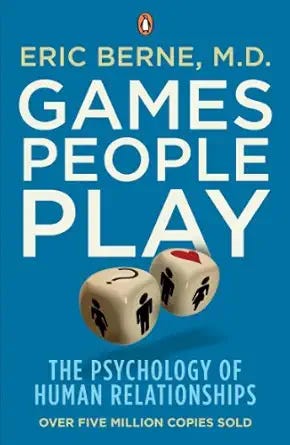
This book doesn’t really have anything to say that you didn’t already know, and its smirking, self-conscious informality gets stale fast. It does, however, feature some amusing anecdotes. One explains this book’s popularity in Bulgaria: a doctor from Sofia and an old village woman focus so completely on the status difference between them that they forget that he should treat her and she should be treated. People do often forget the purpose of whatever they’re doing, so this book does contain some truth. Pirate King of Star Patrol - by John C. Wright 
Athos Lone is a pirate hunter pretending to be a pirate captain — whoops, now an admiral — torn between loyalty to his crew and the law that would see them hanged. It’s an interesting bind, and Wright has gotten Athos in and out of such before. This time, though, he doesn’t. Here’s the author banging his spaceships together in all sorts of interesting ways, but the main character just watches, reporting the action and feeling things about the combatants. It gets dull. And doesn’t anyone notice that Athos isn’t participating in this battle? Galaxy Quest is a fun series and I’ll continue with it, but this episode doesn’t do its job. The Thousandfold Thought - R. Scott Bakker 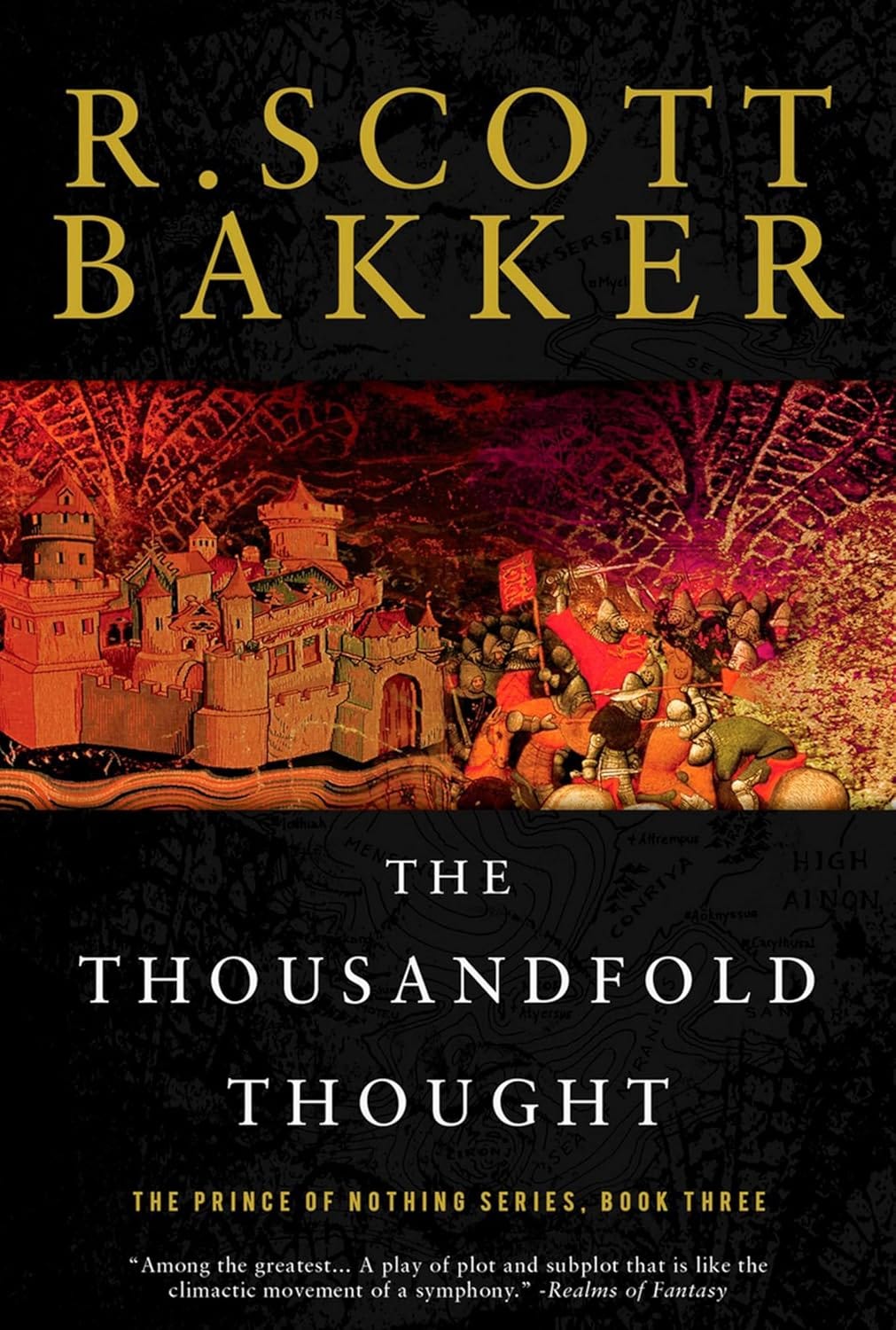
When I recommend The Second Apocalypse series, I tell people to stop with this book. The later ones get increasingly bloated and sloppy, but the first three are tense, forceful, even lovely. Unfortunately, without an ending to build toward, the story is pointless. The author starts with some interesting deconstruction, but once you’ve finished tearing down the old system, you need something to build in its place. Bakker can’t bring himself to make positive suggestions about the way people should live, so he just leaves the characters and their world in a shambles, with nobody picking up the pieces. It’s a purer example of Gen X nihilism than George R. R. Martin’s, and so worth studying. https://www.futuristletters.com/p/the-censor-and-his-writer It’s a heartwarming relationship. Much healthier than the one between the Writer and His Mistress. https://www.youtube.com/watch?v=n7Q1vubN4w8 Man I love military technology. Politics, money, engineering, and the merciless laws of physics and game theory all come together, and prove to you that you did something dumb. https://www.youtube.com/watch?v=99yi0FRF4uM I really want to try that toasted flour idea. https://www.youtube.com/watch?v=aG06yKwabac Now I know how Vantablack works. See you next month.
0 Comments
There is a pair of dragons on the crest of the iconostasis of the village church. Posed like cats clawing an armchair, they flank the skull of Adam and look away from crucified Jesus above. It was more than a little cold in the church. There usually isn’t anyone there, the village isn’t big enough for a dedicated priest. My wife’s mother and grandmother had engaged one for the morning, and he came with a sort of manager, a firm, efficient woman who directed the church to be opened and chairs brought inside. “No,” she told the grandmas, “This money isn’t for us. Everyone takes a candle and leaves some money, and you keep the money at the end. That’s the tradition.” I think her pushback made Baba Vese feel better. By the time I met Dyado Kolyu, dementia had already begun to affect him. Every few minutes, he would have to look around and figure out what was going on. He’d go out into the woods. Why was he there? To find mushrooms. He was at home with a mushroom. Why? It must be for cooking. “Gaba gaba gaba,” he sang, “Mushroom, mushroom, mushroom.” He fried it in butter, but Baba Vese would not let him serve me any of that mushroom. “She says she doesn’t want to create an international incident,” said Pavlina on my first visit to her village. “She’s making him sign a document that says he’s eating that mushroom of his own free will.” He lived for another twenty years. Dyado Kolyu, the son of a forest ranger, escaped the envy of his neighbors in the first decade under the Regime to become a mining engineer. He moved from his little village in western Bulgaria to Sofia, then, at the height of his career, to Algeria. “If you marry while I’m gone,” he told his college-age daughters, “I will never speak to you again.” They were both married by the time he came back to Bulgaria. He replaced both his parents’ house in his village and his in-laws’ house in Sofia. “Look at this wonderful place I’ve made,” he said when we moved him into his new handicap-accessible apartment two years ago, and I realized that for the past fifty years at least, he never lived in any structure he hadn’t made himself. His decline was slow and linear, just a gradual dimming of the light shining through him. I’ve written about how he was in his last months and how Pavlina recognized a best case when she saw it. Better, far better to die in the apartment her children and grandchildren bought for you, surrounded by family, cared for, mourned. Bulgarian funeral arrangements are quick. We found out on Saturday, and by the time we got to the apartment, the undertakers had already come and gone. Pavlina cried and hugged Baba Vese, who kept vigil all that night while the hearse driver got the necessary permission to transport human remains. The funeral was Monday, and Pavlina and I brought our daughters, somewhat in defiance of tradition. They roamed the graveyard until it was time for the service. They had done their mourning on the day their great-grandfather died, and now they were mostly bored or cold or interested in the candles they were holding. I think the grandmas enjoyed correcting the priest. They indulged several times, including when he invoked the blessings of Saint Nicholas. “Nikola.” “No, no, not this Nikola. That one.” The priest pointed to the icon, then upward. “Svieti Nikolai,” he pronounced. The grandmas also told us not to let Maggie and Ellie walk up the hill to the grave, and told the gravediggers not to shovel rocks on the casket. They didn’t get their way either time, and I think that made them feel safe. They did piss off Pavlina, though. “Dyado Kolyu loves us,” she said. “He wants to see his great-great-granddaughters playing.” Nobody asked my opinion, but I do prefer Pavlina’s metaphysics. My own experience with death has taught me that ‘because you live in a universe of uncaring atoms’ is so totally useless it insults me, like being given sand to eat. You cannot confront death without faith. From there, in that yawning absence of evidence, you can fear the ghosts of your loved ones, or you can remember that they love you still. The dragons look away from Christ because he’s beaten them. See you next month. |
AuthorDaniel M. Bensen Archives
October 2026
Categories
All
|
 RSS Feed