
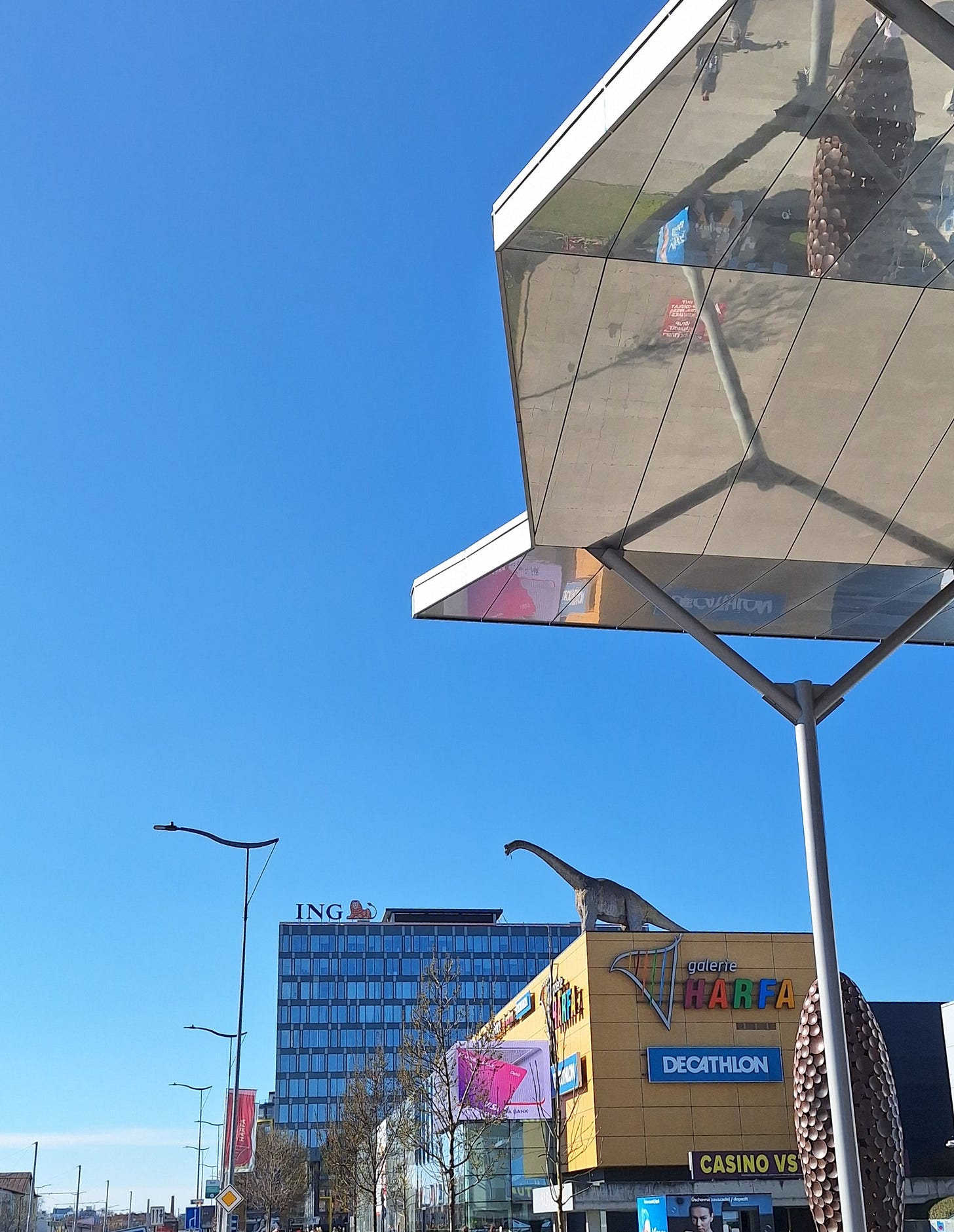
I remember my first scifi convention. I was a little awed, a little Dorothy-opening-the-grayscale-door. I’d married the only girl in college who read Terry Pratchett and Lois McMaster Bujold, and here I was in a convention center filled with fans of scifi. Some might even know more about force fields than I did. Some did, but then came the dreary twenty-teens. One friend called LonCon 2014 the “last safe WorldCon.” Another, when I asked her in 2024, said “why would I pay so much money to spend four days with people who hate me?” As the dreary decade slumped on, I found myself bored, snubbed, and egregiously robbed of my time. And yet here I was again, twelve years later, at Prague Comic Con with my Bujold-loving wife, under the auspices of Anna and her husband, who I’ll call Jakub. Back at their wedding, I’d shaken hands with Anna over a deal to split the cash with her from any publishing projects she could arrange in the Czech Republic, and she’d held up her end of the bargain. She’d invited me to this con and spent the weeks before cold-emailing Czech publishers about my work. On the first day, she marched up to a pair of comic localizers and introduced herself as my agent. At first, I was more of a good sport than a participant in Anna’s machinations. Pavlina found wearable kitty-cat ears for our daughters, but there was nothing I wanted to buy for myself, and my backpack was quite heavy. But then we passed the booth set up by the Czech armed forces, with all these little plastic doodads arranged on a table. One of them looked like a pineapple. “What’s that?” I asked the soldier behind the table. “A proximity mine!” he said, absolutely delighted to speak with me. “From Italy. It has magnetic coils inside. If something made of metal passes close enough, it detonates.” “How do you bury it?” “You don’t need to.” “So, you hide it in the bushes…” “You don’t even need to do that! If you’re entrenched somewhere in Ukraine, and you want to deny an area to the Russians, you put these things in a field. They can’t roll their tanks through before they clear out the mines. It’s called ‘area denial.’” “Wow,” I said, “you don’t even bury the mines. You could paint bright colors to —,” I was going to say ‘to warn away predators,’ but the soldier evaded my dumb joke by hopping over to another display. “This is a butterfly mine.” It was the size of my hand, with two lobe-shaped fuel tanks connected by a thumb-sized detonator. “It detonates when you step on it or squeeze it. The Serbs,” he said, “painted these things in bright colors, so that children would pick them up.” What is the frame of mind of a person who makes mines in tempting colors? It was a cold thought in that noisy, dazzling event space. Clarifying. We all have goals, especially if we don’t admit them to ourselves. The Czech government wanted to recruit the sort of young man who thinks Warhammer 40K is cool. The publishing houses wanted to sell books, and the fans in T-shirts, cloaks or space-armor, wanted to become something larger than themselves, to have fun and find meaning at the same time. Anna, for her part, was determined to find paid work. She set me up for coffee with a Czech author, who had a village house he wanted to fix up. Thinking about it now, I realize that conversation would have gone better if I’d connected him with my father-in-law, who knows how to design a brown-water recycling system. Instead, I talked about what I wanted, which was for hundreds of thousands of people to read my books. We made no particular connection. But Anna and Jakub weren’t done. He translated a whole marketing panel to me in real time, and she parlayed a series of short conversations into a meeting in the event center’s cafeteria with Jan Kotouč. Jan Kotouč is another of Jakub’s favorite authors, a prolific writer of scifi and alternate history, and one of the few in the Czech market who supports himself entirely with his fiction. I’d had enough of talking shop, though, so I asked him about his next book. Kotouč wanted to explore space warfare at close range. Using their zero-acceleration drives, ships would instantly gain velocity, flashing past each other dogfight style, while deflecting each other’s missiles and lasers with shields. What an image! “Okay!” I said. “So, these shields. When they turn on, do they do this?” I pushed a pepper shaker away from a salt shaker. “Or this? I chopped the edge of my hand onto the pepper shaker. “If the first, one ship can get in close to another, turn on its shields, and bash the other one. Bam! Like bumper cars. If the second, you can have a small ship or a drone that gets in real close, flicks on its shields, and slices a spherical chunk out of the side of the enemy ship. You know what this guy in the army just told me about area denial?” “Probably not possible in space,” said Jakub, who designs the guidance and control systems of satellites. “Too much volume to defend.” “So, you’re American?” Kotouč asked Anna. “What do you do?” “She’s an editor,” said Jakub, and Kotouč refocused. If he’d had kitty-cat ears, they would have perked up. “Really?” he said. “I have students who write in English and they need an editor.” Anna was overjoyed. Here was some real work. It was the last day of the con and people circulated tiredly through the cafeteria. Furries in body-suits, fathers pushing strollers, high school sweethearts who’d just spent four thousand koruna on books, and writers trying to look professional when really they were desperate to get their stories out. They seemed to work well together. There was a sense of, if not community, at least health - readers, writers, and publishers all going home satisfied. Anna got a very warm lead on an editing gig, Jakub bought books, my daughters got fuzzy new ears, and I now know what a green shoot looks like, poking up through the ash.
0 Comments
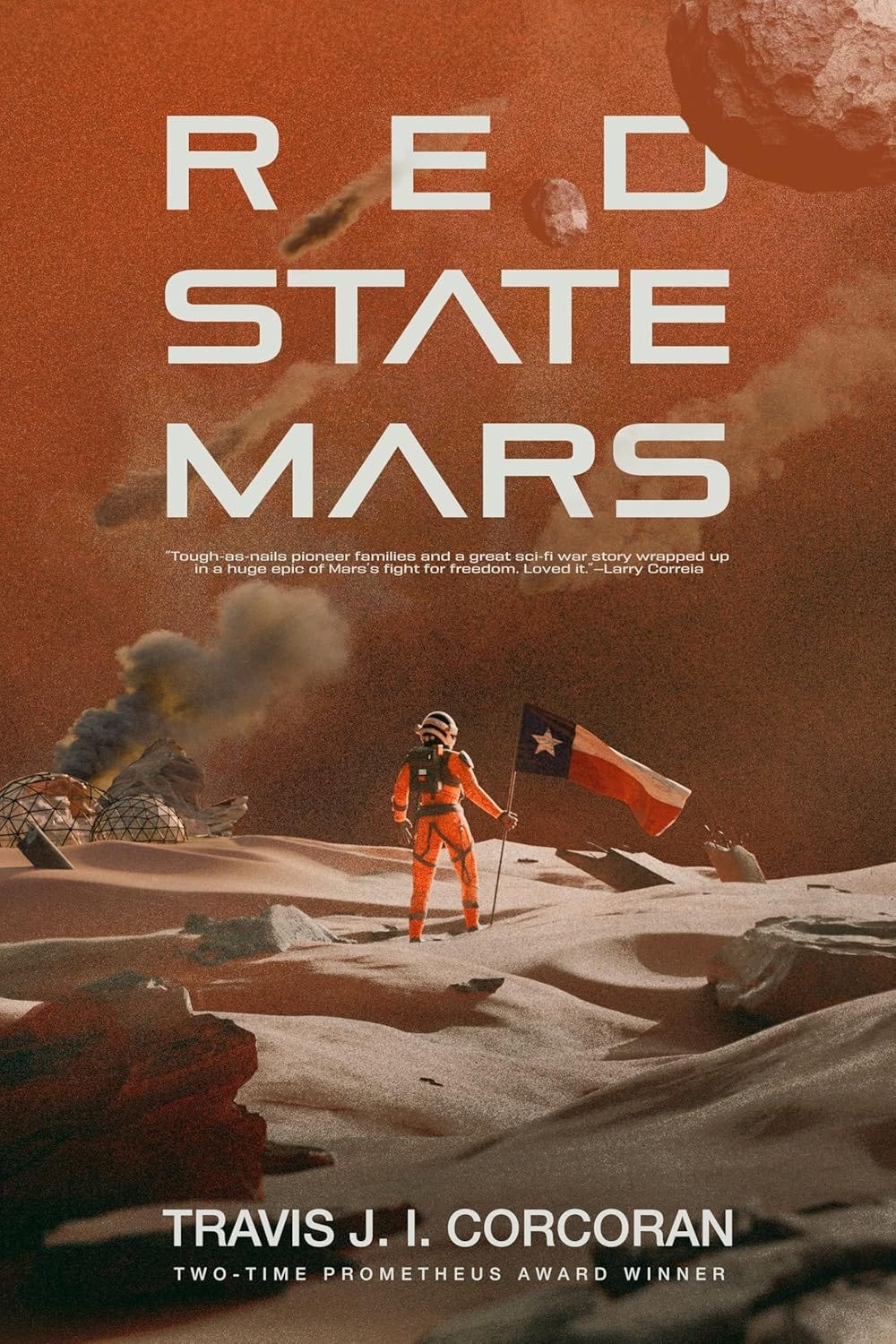
Red State Mars is the best new science fiction book I’ve read since Project Hail Mary, and not for lack of trying. I’ve searched desperately for years for an alternative from the industrial slurry extruded by Tor, Daw, and Ace. Yes, I have found a few indie gems, such as Corcoran’s Aristillus books, which describe how a single breakthrough technology can threaten even the most entrenched of powers. They were good books, but now Corcoran has an editor. This, Ark Press’s first book, is beautifully polished. Red State Mars follows the formation of the first Martian state, founded by a coalition of five Texan clans, which themselves coalesced in the anarchic aftermath of World War III. Now, after three generations of peace, they find themselves in another violent Turning, as foretold by Strauss and Howe. In response to the ever-escalating demands of the technocratic eugenicists of the Unitary Sovereign State of China, the Martian clans must put their differences aside and fight together. Corcoran shows us the war through the eyes of three men: Will, a teenage boy with a dog who goes on Heinleinian adventures as he becomes a soldier; his nerdy uncle Brian, who wins the love of a good woman through feats of engineering; and his father, Jim, who is so used to leadership he’s gone soft, and is forced to admit that even he is not done growing up. Corcoran has been paying attention to many Thanksgiving-table arguments. In the afterword, the author says he planned Red State Mars as a family saga, but that isn’t how it turned out. Under the guidance of editor Tony Daniel, the older generation’s stories were moved to a separate novella, resulting in a tighter, quicker-launching book. I actually think they could have gone further in this direction and brought more out of Will, Brian, and Jim, but that’s a quibble. Here’s another: there were some dropped threads. What happened to the young Mormon guy with the wire-rimmed glasses? Why did they use the tainted feedstock? Maybe I missed his answers, but I got the impression that Corcoran had too many balls in the air, and dropped some. Anyway, the battle scenes were exciting, suspenseful, and technical in the best tradition of Clive Cussler. Satellites, molten salt cooling systems, and missiles all get their chance in the point-of-view spotlight. LLMs are ubiquitous in the 22nd century, where every armored fighting vehicle quotes doctrine and every valve has a opinion. It makes sense for the machines’ voice to be close third person. As in the Aristillus books, Corcoran is conscientious with his future technology. There’ve been incremental advances in AI, 3D printing, and genetic engineering, but there’s just one black swan: the force field generator. There were chapters of Red State Mars where I alternated between reading about space-explosions and furiously imagining force field tactics. Can you batter through a force field? Yes. Can you reshape it at will? Yes. Can you thrust or see through it? No. But you can flick it on and off rapidly in sync with your cameras or engines. Of course, if you do that, weapons can sneak in. Beautiful stuff. And don’t get me started on what impermeable, immaterial walls mean for nuclear fusion. Leave that up to Corcoran. There’s quite a lot of town-hall politicking, which was gripping even compared to the coming-of-age-through-microgravity-combat scenes. I was never more emotional a reader than during those debates. Stop interrupting each other! This is a book about people’s love and loyalty to a place and each other. It gives us what a good story should: a perspective on ourselves, and a view of where we might go from here. I am delighted, inspired, and even hopeful having read this book. It seized me, it pushed me, it scintillates with the possibilities of the future. It’s exactly the sort of story I couldn’t find for a bleak, censorious decade. And it’s only Ark Press’s first. May there be many, many more. |
AuthorDaniel M. Bensen Archives
October 2026
Categories
All
|
 RSS Feed