
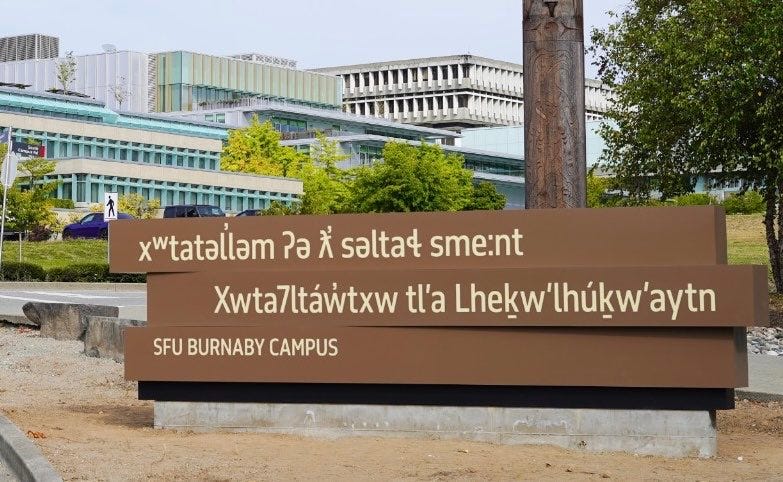
So, the sign in front of the SFU Burnaby Campus says: xʷtatəl̕ləm ʔə ƛ̓ səltaɬ sme:nt Xwta7ltáw̓txw tl’a Lheḵw’lhúḵw’aytn Why? Why do that to a language? No, I’m not talking about acknowledging native peoples (the stewards of the land). I like seeing Salishan languages on signs - it’s amazing you can be tooling around the Pacific Northwest and run into something as different from English as Japanese. The problem is the writing system! Imagine you’re a Squamish 1st grader and your tribal school gives you Lheḵw’lhúḵw’aytn to read. What good does this pseudo-international-phonetic orthography do for language revitalization? It’s as if aliens conquered the Earth and made us spell our language ðįgłšlĕęgʷıdž because it’s more “accurate” to the pronunciation. This is base obscurantism, designed to intimidate non-linguists who don’t know what a superscript w symbolizes. Just look at the letters they foisted upon the (sigh) “hən̓q̓əmin̓əm̓” and “Sḵwx̱wú7mesh” languages. Come on. Write them Halkomelem and Squamish, like a normal person. And that’s the secret. We have a perfectly good way to spell words in these languages already. There are Salishan names on places all over the region. It was a simple (two-week) process for me to figure out how to transform the “official” orthographies of these place names to their pronounceable common-use alternatives. taqʷúʔmaʔ > Tacoma
spúyaləpabš > s-Puyalup-amish
nuxwsá7aq > Nuksack
secwépemc > Shuswap-im
sḵwx̱wú7mesh > Squamish
sduhúbš > Snohomish
sqáǰət > Scagit
c̓x̣íl̕əš > Chehalis
ts’elxwéyeqw > Chiliwack
kʷíkʷəƛ̓əm > Coquitlam
sp̓q̓n̓iʔ > Spocan-i
snunéymuxw > s-Nanaimo
w̱sáneć > Sanich
síʔaɬ > Seatl
snpíntktn > san-Penticton
osw̓íw̓s > o-Soyus
shíshálh > Seshelt
qlispé-l > Calispe-l
quw’útsun’ > Cowichan
séliš > Salish
You notice I didn’t get the spelling of every city name exactly right. There’s some random chance in the ways these words got written down. What’s important is to read this damn sign: Tatillim a tla Saltelt Smaent - the “Campus of the Burnaby Mountain” (from the Hancaminam root tatil-, “to learn”). I insist that this is a better writing system than the official one.1 Yes, it’s not always clear whether an l is voiced or not, or where the glottal stops are. That’s true in English as well. As a speaker of the language, you learn where the grace notes go, but the the basic starting point should be clear at first glance. The point here is to make learning Squamish easy. That’s how you keep a language alive. 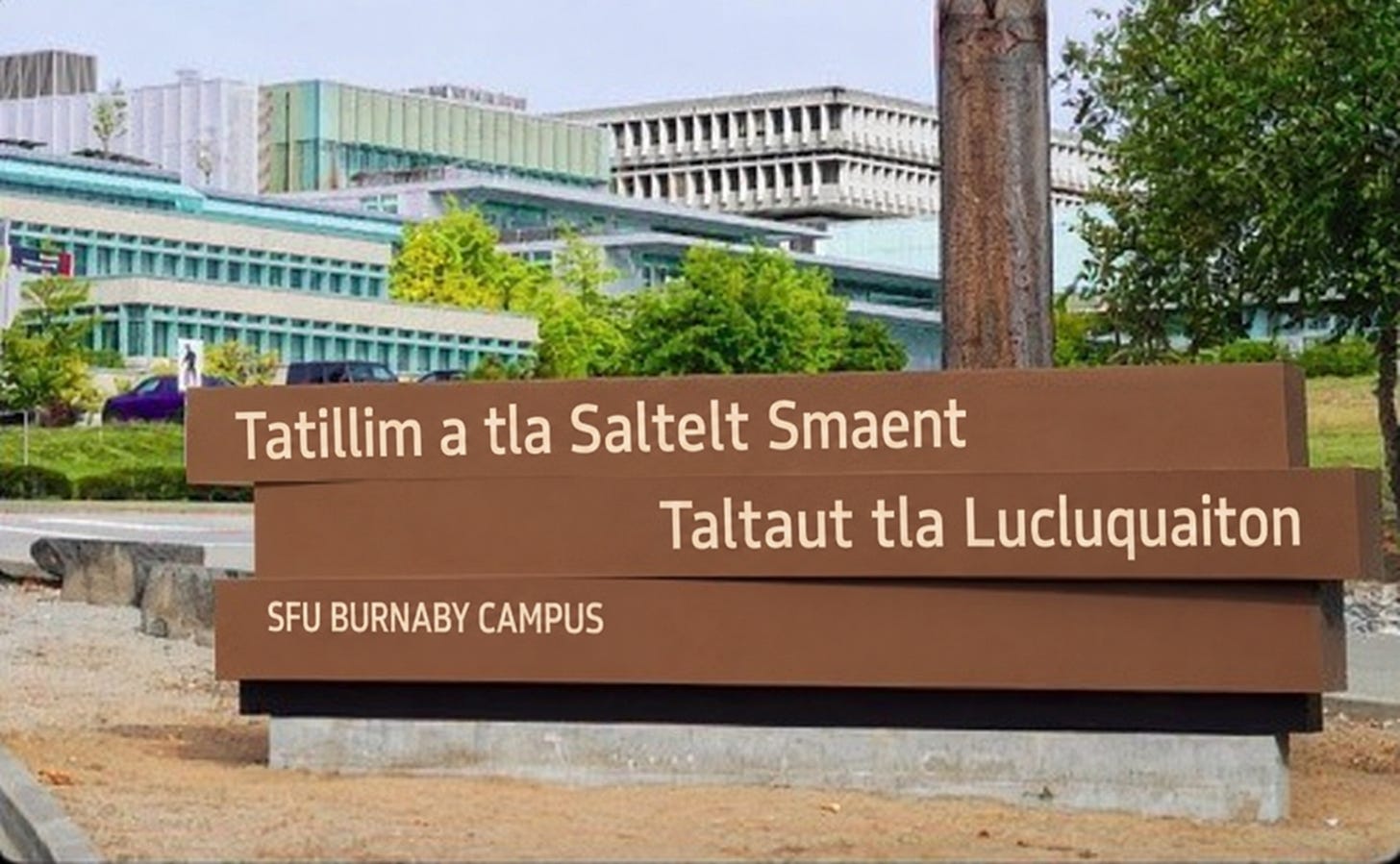
See? I fixed it. 1. With the caveat that I don’t claim to have done a perfect job. If I had more time, I’d try to get the epithentic vowels closer to where Salishan speakers put them, rather than English speakers. I’d also try harder to draw the spellings of these languages together. Ideally, a speaker of one Salishan language should have a good idea of the meaning of a sign in another Salishan language. If there’s interest I’ll do it. ↩
0 Comments
Leave a Reply. |
AuthorDaniel M. Bensen Archives
October 2026
Categories
All
|
 RSS Feed