
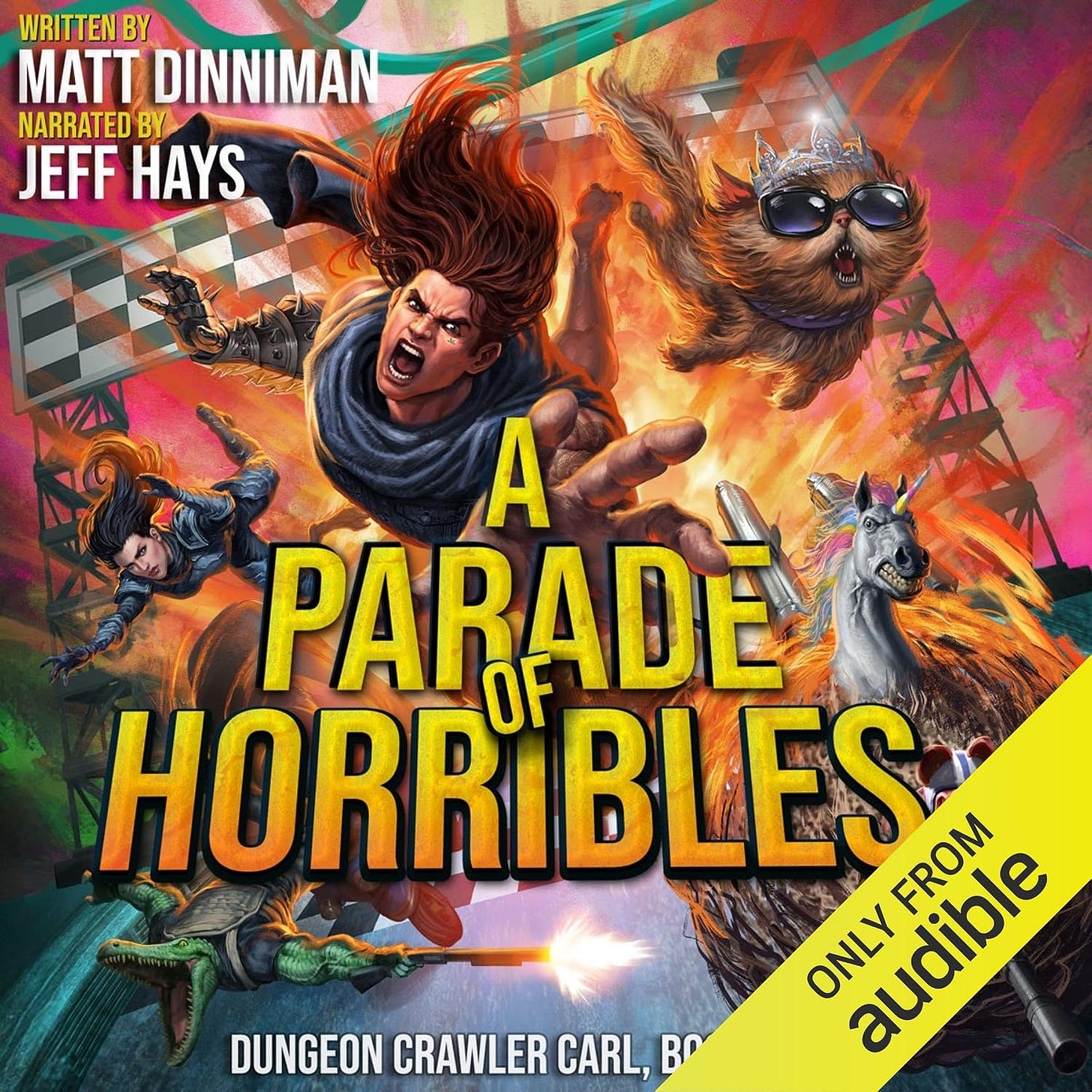
A Parade of Horribles by Matt Dinniman I didn’t want to write this review, but it might do someone else some good if I warn them off. You can read my previous reviews about the fun I had for years reading these books. They were great for airplane rides or bed after a long day. But then… It’s not that the author got political, or even that he got Left-political. Yes, the justifications for killing the evil Oppressors became thin, and their crimes against the good Victims became more nebulous (see the execution of D’nadia). And then there was a lot of talking about sex (blow-up dolls, dick jokes, strippers) but very little that was actually sexy. I didn’t like the way the author wrote to and about his readers: “I want people with different points of view to enjoy these books at face value. If I then manage to drill through their thick skulls and make them think about the broader themes and maybe grow an empathetic spark, all the better.”1 But even that didn’t make me stop reading. I finally gave up on a plane, when I had nothing else to do, when I came to this: “Dwight is known for being a complete prick … He’s the type of guy who would one-star an upcoming video game because the artists had the temerity to draw a female character who didn’t give him an instant erection.” All right. I don’t play video games, but (to paraphrase Pratchett2) I know when someone is drawing a line between good and evil and putting me on the appropriate side. I thought we were past this. I thought the Left had figured out that their fake civil war wasn’t going to work. Apparently not. But fortunately there are now books being written that are not about how Blueside rules and Redside drools. I returned Dinniman’s capering agit-prop to Kindle Unlimited, and picked up The Earthen Dark, which enthralled me until landing. 
Starship Troopers by Robert A. Heinlein Last month’s Tortuga Book Club book. Read more about it here, where Pavlina speaks with more heart and brain than I can usually manage. All I can say is Heinlein wrote this book when he was angry and having fun. The fun part is everything except the civics classes. About them I don’t have much of an opinion, but Tom Kratman sure does. There’s surprisingly little bug-killing in this book, and not much on-screen romance or even friendship. All that stuff, the blood and soul of the book, is in the background, under the surface, while we follow a somewhat dumb, very honorable mech-soldier’s daily life from boot camp to officer-hood. It’s almost all “what,” without much “why.” But the “why” is there. 
The Information State by Jacob Siegel I was put on to this book by Matthew B. Crawford, who has done more than anyone else to answer the question “What the hell is happening to America?” https://mcrawford.substack.com/p/the-fate-of-liberty-in-the-american In Crawford’s words, “beginning in late 2016, techniques of information warfare developed in the Global War on Terror were turned to domestic purposes by the outgoing Obama administration, to counter the populist threat.” I would like to know more! For example, did you know the failed military surveillance experiments of the Vietnam War ended up imported back to the US as the Internet of Things? So, when someone said, “The Twitter Files were a few people who didn’t have a good time on the internet,” boy was I ready to rebut him. This is a great book to inform your arguments with your friends. 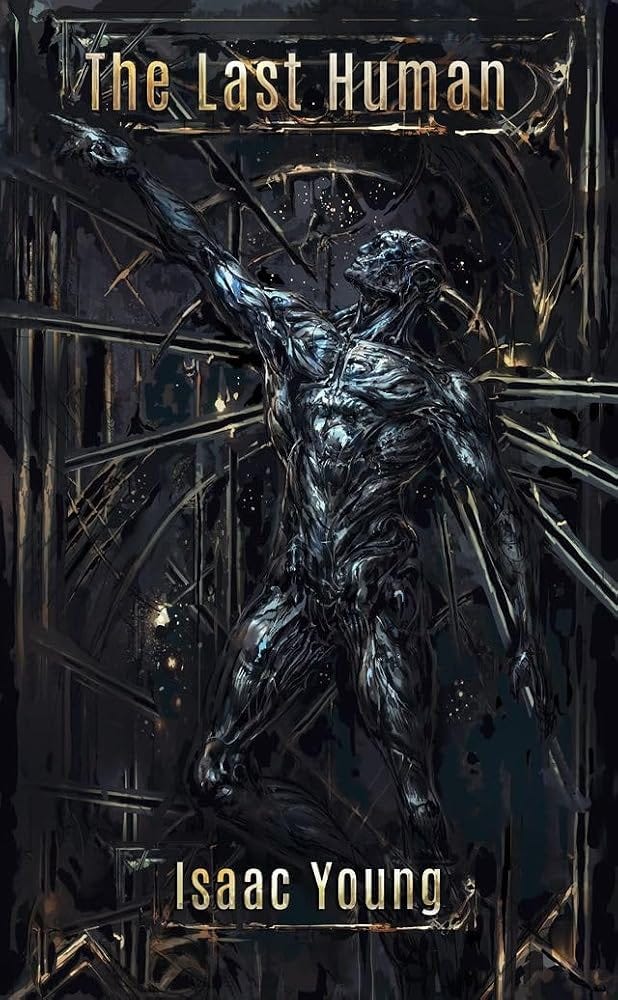
The Last Human by Isaac Young See my podcast about it for the more complete picture, but in short this is a grim and thoughtful book, better written than The Domes of Calrathia, but still not quite “good.” There were scenes with no point (the spider man), and obscure descriptions. When describing a Dalfaen, for example, the narrator says, “What horrified me was that the unwanted face that seemed grafted onto disobedient flesh was so similar to mine own.” What he means is that these uplifted dolphins had grafted the faces of humans (their creators) onto their flanks. That’s a good and creepy expression of the book’s themes, but you have to work at clearing away the verbiage to form the picture in your head. The Last Human is heartfelt, though, honest and meaningful. That’s more important than mere intransitive verbs or dangling participles. 
The Populist Delusion by Neema Parvini I read this one for the Tortuga Book Club. Professor Axelrod can tell you more, but here’s what I got: anyone who cares about doing good work will inevitably lose his position of leadership to someone who cares about occupying that position. Thus, no organization will be run by anyone other than grasping, scheming, power-hungry bastards. If you think you saw popular revolt against the elites, that’s just what They want you to think! The best we can hope for is that the elite faction most aligned with our interests wins, or that we can learn how to grasp and scheme ourselves. I can’t say I’m convinced. Even if you replace “inevitably” and “anyone” with “usually” and “most people,” I think there’s more to the battle between Machiavelli’s Lions and Foxes. What about the Hunter? Not to mention the cold, uncaring laws of physics. There are dangers to which even rulers must bow. 
How to Read a Book by Mortimer J. Adler and Charles Van Doren I read this book and was soothed, intrigued, excited, and angry. The authors write with admirable clarity and forthright common sense, leaving you with no doubt you’re in good hands. They give you techniques: read with predictions, questions in mind, theories to test on the book, with a pen in your hand. Adler and Van Doren saved Rules for Radicals, another Tortuga Book Club book, because it turned Alinsky’s duplicitous smokescreen into a game. (Question: Whom does Alinsky think he is fooling? Wait until next month to find out.) I’m eager to apply Adler and Van Doren’s tools to all the classic books I haven’t read, or have read sloppily, but that’s also why I’m angry. Why didn’t anyone tell me how to read a book? What the hell kind of education did I get in high school? Thank goodness I’m raising the next generation in Bulgaria, where my eighth grader’s teachers are making her memorize the Iliad.3 
Memory by Lois McMaster Bujold This book is from the stratospheric run of middle-late Vorkosigan adventures, when Bujold reached higher with each book. Memory is very structurally interesting, appearing to meander a whole awful lot (there are scenes where the characters wonder aloud what they’re supposed to do next), but people keep finding things to do and meanings to extract from those deeds. It’s like life, and when you zoom out you see the bigger patterns, and you wonder whether the author knew what she was doing after all. I don’t recommend reading this one first. You need to know who Miles is before you find out who he isn’t. Start with The Warrior’s Apprentice. Peter Northrop’s voice is annoying, and he goes off on these blithe riffs when he feels the need to cover his ass ideologically (“the point of this video isn’t to overhype the promise of AI or be a cheerleader for big pharma’s complicated role in the broader scientific landscape …”). Aside from that, though, these videos are perfect. The animations are fun, informative, and beautiful. The explanations are just complicated enough to be accurate. The beauty of nature shines through everything, transmitted by the creator’s very real love of biochemistry. I recommend starting, of course, with caffeine. https://www.youtube.com/watch?v=fNR-GY-WoAI I’ll be honest. Sometimes these guys are too much for me. Too crude, too loose. They’re not kidding when they say they’re gentlemen retards. This episode, though, they bring in Cremieux, who is nothing if not gentlemanly. Just listen to the way he pronounces “literature.” Cremieux has important things to tell the dude-bros. They want to know. They ask good questions. The funny, enlightening, and (if you didn’t already know about the replication crisis) horrifying conversation that ensues is the best evidence I’ve seen that even the most based of us do still “trust the science.” They just don’t trust scientists. See below. I did not like this video. I include it here because it is a helpful illustration of something dishonest that academics do: dissolve a picture into a mess of exceptions, edge cases, and contradictory assertions. The tidy borders you draw between one language and another break down, don’t they, when we consider minority languages, multilingualism, dialects of varying intercompatibility, and government fiat. Really any accurate map is impossible, and only valuable as raw material for postmodern deconstruction. What angers me is how badly this method of un-explaining serves students. What if I don’t already know what languages they speak in Switzerland, and want you to teach me? Saying “Switzerland has more speakers of Portuguese than Romansh” only makes sense if I already know what Romansh is in the first place. Ridiculing the simple picture gives you no platform on which to build the complex one. Without that foundation, you don’t get enlightened nuance, but murky incomprehension, not to mention the fear of being called out as an ignoramus. Someone de-educated in this way might trust scientists, but only because he can’t understand them, and he’s afraid to admit it. https://www.youtube.com/watch?v=hX21ctsGhNc And that’s not all! My negative reviews from last month sparked some lively debate on Twitter. In response to my disappointment that the space suit on his book’s cover never went to space, Fenton Wood responded: https://x.com/WoodFenton/status/2103554749882830888 And in response to my assertion that Gene Wolfe’s A Borrowed Man was dumb and not worth finishing, ReReading Wolfe directed me to this essay by James Wynn. What I ought to do now is go back and finish reading A Borrowed Man, to see whether Wynn’s theories about the book are supported. Stay tuned. If you disagree with me, tell me so. Maybe you’ll teach me a lesson. 1. From “We are not talking current event politics here” ↩ 2. “the assembled Brethren mentally divided the universe into the deserving and the undeserving, and put themselves on the appropriate side.” And he was paraphrasing Solzhenitsyn. ↩ 3. No, not all of it. The pansies. ↩
0 Comments
Leave a Reply. |
AuthorDaniel M. Bensen Archives
October 2026
Categories
All
|
 RSS Feed